
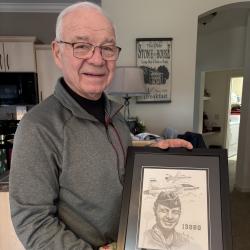
I grew up always loving airplanes. One day, at about 8 years old, I was working with my uncle, a former USAF Pilot, at my grandmother's kitchen table. He was looking for something in a container that contained "Miscellaneous" things, proceeded to pour it out onto the table, and out rolled his Air Force Pilot wings. Knowing nothing more than what had just happened, my immediate thought was "I want a set of those." We built model airplanes, he took me to airshows, and I was hooked.
Growing up, I had two major hobbies - model aircraft and amateur radio. I had no idea as to the power of either to support a successful career, other than I needed to know more about electronics. I studied electrical engineering at Northeastern University. My flying was on hold as I went through college. I raced sailboats, participated in Intramural gymnastics (as a very poor one at that), and graduated with a BS in Electrical Engineering. That was the time of the draft, and my number was close to being called. I signed up with the Air Force and was fortunate to be selected for Pilot Training. Suddenly, it was flying. I earned my own set of wings in February 1972. My amateur radio interests took a back seat, as my Air Force career took me from flying the T-33 to instructing other pilots in the T-37. It was then that pilots in my group were being assigned to non-flying jobs, so I was fortunate to be selected for graduate school at the Air Force Institute of Technology in Wright Patterson AFB, Ohio.
Back into the engineering field, I worked on the source selection for the Advanced Fighter Technology Integrator (AFTI) program. The AFTI F-16 was selected. What an experience. Back to flying was my assignment to Yokota Air Base, Japan, flying the C-130 aircraft to support the missions across the Pacific Theater of Operations. From the C-130, I went to instruct in the T-38 at Lubbock AFB, TX. Then, because I had my Masters from AFIT, I went to teach electrical engineering at the United States Military Academy, West Point, NY. It was there I was able to return to my love of Amateur Radio. After retiring from the USAF, I did some general aviation flying. After several years, I began instructing computer courses at the University of Maine at Augusta.
I now had time to work on RC Aircraft. It should be no surprise to read that I, after 3000+ hours in full scale aircraft, knew nothing about RC. So, I learned, albeit slowly. In 2013, my career took a significant shift. The university was launching a flight training program, and I became the aviation program coordinator. What an honor. With support of the school, and a decade of experience in the job, we are now bringing the University's Flight Training program to the competitive level I have dreamed of. We soon will have a full 6-Degree of motion simulator for the Cirrus SRxx aircraft, Virtual Reality with AI student-centric training, and will be a source for the next generation of professionally trained commercial pilots.
One of my private pilot students, a dad, had a son that he would bring along on flights. Seems his uncle was into RC airplanes. What a combination. Dad now has his private pilot certificate, and his son is totally into RC (with some of my donated planes) and off to a solid future. Often in life, we get to influence the Ones and the Twos. This is a One I am exceptionally proud of.
I now have students we have "raised' in our program that are teaching for us.
This is just as it should be.
Without model aircraft and amateur radio, I would probably be without this story to tell.

