
My RC Journey
My journey into RC aviation started the same way a lot of modern stories do—by accident. A video popped up on my Facebook feed one day, and something about it grabbed me. I didn’t even know why at first. I just knew I wanted to understand it. That curiosity quickly turned into hours of research and watching videos, which eventually led me to buy my first RC aircraft: an Arrows Bigfoot from HobbyZone.
Those early flights were rough. I had no idea what I was doing, and the Reflex gyro system on the Bigfoot was actually working against me instead of helping. Crash after crash followed. Frustrated and looking for help, I reached out on Facebook—only to discover that an old friend, Dean, had years of RC flying experience that I never knew about. He came out to the field, flew the plane, confirmed the gyro was faulty, and helped me get a replacement. That moment changed everything.
After Dean showed me the ropes and I had a working aircraft, I flew every single day. Soccer fields, my kids’ school, Freedom Park—any open space became a runway. I was logging over 65 takeoffs and landings a day, limited only by battery life. That’s where I learned one of the core beliefs that still defines me as a pilot today: landing is an art. You never have to take off—but you always have to land.
After about six weeks, things started clicking. My hands were learning, my confidence was growing, and flying became intentional instead of reactive. I expanded into high-wing aircraft—two HobbyKing Tundras and an FMS Super Cub, all on wheels and floats—continuing to refine precision and control.
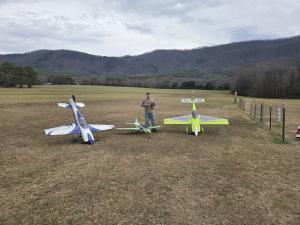
Eventually, I joined a local RC club in Bradley County, Tennessee, where I mostly flew solo and focused on sharpening my landings. Wanting more community, I later joined McMinn County RC, even though it meant a 45-minute drive. The amenities were fewer, but the view and the people made it worth every mile. That’s where I met close friends Blake, David, and Randy, and where we spent countless weekends at the field from sunup to sundown.
A major turning point came when I attended my first fly-in event. I showed up expecting foamies—and instead saw 3D balsa aircraft defying gravity and turbine jets roaring down the runway. It was intimidating. Overwhelming, even. But I was hooked. I met pilots like Donald, an amazing 3D pilot, and Kris from Full Throttle RC, and even had a chance to buddy-box a 3D plane … which I politely avoided by claiming I hadn’t brought my transmitter. I knew I wasn’t ready—yet.
Then fate stepped in. I won a 61cc GP engine in the raffle. That sealed it.
Nine months into the hobby, I bought my first gas aircraft: an 85" Extreme Flight Gamebird. I still remember the sound and the smell—Redline two-stroke oil mixed with 92 octane pouring from the exhaust. I was in love.
I owned that plane for three months before flying it solo. With Donald’s help, I set it up and flew it under supervision. One cold, calm evening after work, I finally went for it alone. I ran the engine up and down the runway, searching for excuses not to fly. When I couldn’t find one, I committed.
The plane lifted like a dream. A few laps in, I tried a corkscrew—it spun so fast my hands started shaking uncontrollably. I landed shortly after, misjudged the runway by a few feet, and touched down in tall grass. The plane tipped. Crack. Both wheel pants were gone—but the aircraft was otherwise perfect.
I took the gear off entirely and flew it that way for months, refusing to reinstall it until I knew—really knew—I could land it.
That experience led to the most pivotal moment in my RC growth: simulator training. Using the same transmitter I flew at the field, I trained at home on my PC. Everything changed. My fingers learned, control surfaces made sense, and my understanding of aircraft behavior deepened. My confidence skyrocketed.
Within a year, seasoned pilots were asking me to maiden and trim their new aircraft. My flights became smooth, my landings decisive. I was flying inverted, knife-edging, pop-topping—and doing it with control and intent.
Today, less than four years into the hobby, I’ve progressed into turbine jets. I currently own a 2.1m Skywing Falcon powered by a 140 turbine, which will serve as my trainer jet as I work toward my waiver. While waiting, I fly jets daily on the simulator and EDFs whenever possible.
Beyond flying, I love to build and create just as much. I’m a problem-solver at heart. I’ve designed over 30 unique 3D-printed components for aircraft ranging from 3D planes to turbine jets, and I’m constantly developing new solutions. I have plans to start an LLC to sell off-the-shelf and custom RC parts worldwide, and I’m actively searching for a long-term career within the RC aviation industry.
When people hear my name, I want them to think of a precise, well-rounded pilot—someone skilled, approachable, and always willing to help. I run multiple radio protocols, assist others with setup and troubleshooting, and design parts when hardware stands in the way of progress.
RC aviation isn’t just a hobby to me.
It’s a passion. A calling. A lifestyle.
If you’d told me four years ago that RC aircraft would change my life, I would’ve laughed.
Now, I couldn’t imagine life without it.

